
Tardigrades glow deep blue and remain unaffected by UV rays, says study
A new study published in the journal 'Biology Letters' suggests that various species ranging from bacteria to birds show the presence of fluorescence
- Science News
- 2 min read

;'%3e%3cpath%20d='m8,15.99c4.41,0,7.99-3.58,7.99-7.99S12.41,0,8,0,0,3.59,0,8s3.58,7.99,7.99,7.99Z'%20style='stroke:%23fff;%20stroke-miterlimit:10;%20stroke-width:.02px;'/%3e%3cpath%20d='m3.08,3.37l3.82,5.11-3.84,4.15h.87l3.37-3.64,2.72,3.64h2.94l-4.04-5.39,3.58-3.87h-.86l-3.1,3.35-2.5-3.35h-2.94Zm1.27.64h1.35l5.97,7.99h-1.35l-5.97-7.99Z'%20style='fill:%23fff;'/%3e%3c/g%3e%3c/svg%3e)


A new study published in the journal Biology Letters on October 14 suggests that various species ranging from bacteria to birds show the presence of a naturally occurring fluorescence. However, the functional significance of this phenomenon still remains unknown. As per the study, it does provide a visual communication signal to birds.
Naturally occuring fluorescence observed
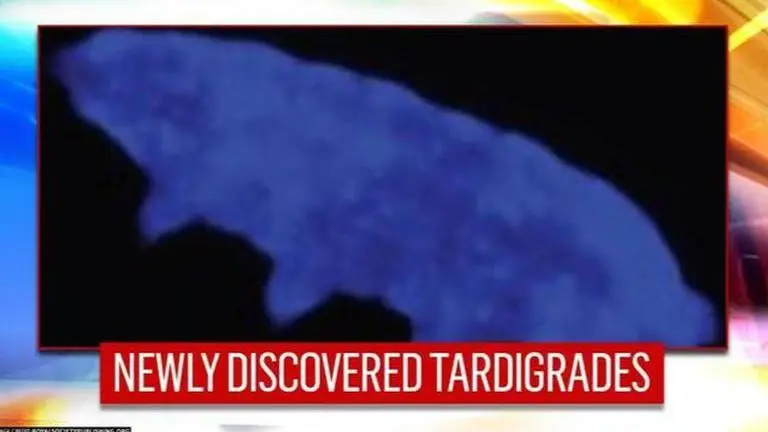
Scientists discovered a new species of tardigrades, known as the Paramacrobiotus BLR, which remains unaffected when exposed to the harmful UV radiation. Tardigrades are microscopic animals with four pairs of legs and about 1,300 species have been reported under this category from across the globe.
The study says, “The phylum Tardigrada is included in the superphylum Ecdysozoa along with its sister phyla: Arthropoda, Onychophora and Cycloneuralia. Terrestrial tardigrades, in cryptobiotic state, can tolerate harsh conditions such as extreme temperature and pressure (high and low), ionizing and ultraviolet (UV) radiations, osmotic stress, and even space vacuum at low Earth orbit”.

(Paramacrobiotus BLR strain shows tolerance to UV radiation and exhibits fluorescence under UV light. Image Credits: royalsocietypublishing.org)

(Transfer of UV tolerance property from Paramacrobiotus BLR strain to H. exemplaris and C. elegans. Image Credits: royalsocietypublishing.org)
As a part of the study, it was revealed that the Tardigrades have a biological shielding mechanism. As a part of this mechanism, animals absorb the dangerous radiation and convert it into deep blue light. To study the process in detail, the team of scientists divided the species, Paramacrobiotus BLR, into two parts. One part was exposed to the radiation and the other was kept far away from it. It was then concluded that there was no difference in terms of egg laying and hatching. Also, the treated sample displayed some natural fluorescence where it was turned blue.
Advertisement
The study read, “60% of Paramacrobiotus BLR specimens survived 1 h exposure to germicidal UV radiation. After UV radiation treatment, tardigrades were observed daily for signs of life—active movement and egg laying. There was no significant change in the number of eggs laid, their hatchability and the hatching time, between UV-treated and untreated Paramacrobiotus BLR specimens”.