
Oil at $108: Will Trump’s ‘Project Freedom’ Save India or Push the Rupee to 98 Per Dollar?
President Donald Trump’s "Project Freedom" aims to crash global oil prices by clearing the Strait of Hormuz. But for India, the plan is backfiring. Instead of cheaper fuel, it has sparked military conflict, keeping Brent crude above $108. With the US Navy now engaging Iranian forces, experts warn of a flight to safety that could sink the Indian Rupee to ₹98/$ and trigger a massive energy shock by late 2026.
- Republic Business
- 3 min read

;'%3e%3cpath%20d='m8,15.99c4.41,0,7.99-3.58,7.99-7.99S12.41,0,8,0,0,3.59,0,8s3.58,7.99,7.99,7.99Z'%20style='stroke:%23fff;%20stroke-miterlimit:10;%20stroke-width:.02px;'/%3e%3cpath%20d='m3.08,3.37l3.82,5.11-3.84,4.15h.87l3.37-3.64,2.72,3.64h2.94l-4.04-5.39,3.58-3.87h-.86l-3.1,3.35-2.5-3.35h-2.94Zm1.27.64h1.35l5.97,7.99h-1.35l-5.97-7.99Z'%20style='fill:%23fff;'/%3e%3c/g%3e%3c/svg%3e)


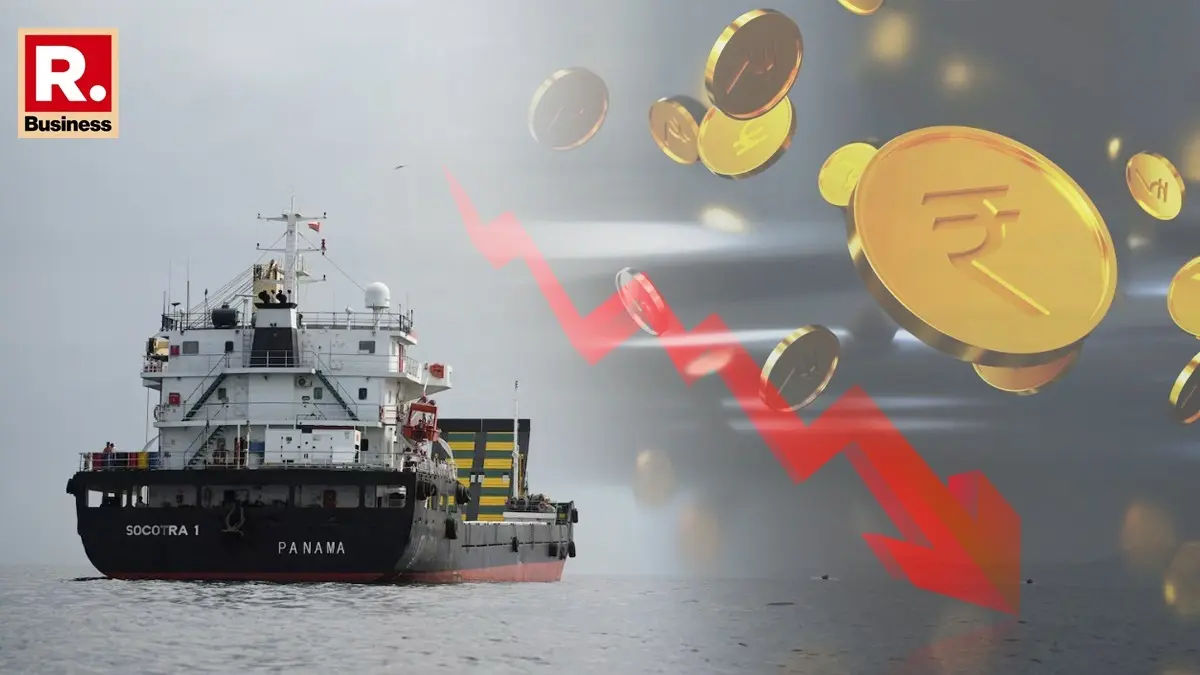
U.S. President Donald Trump’s "Project Freedom" was supposed to be the ultimate relief valve for global energy. By using the U.S. Navy to escort tankers out of a blocked Strait of Hormuz, the mission intended to flood the market with oil.
Instead, the mission has turned the world’s most vital shipping lane into a combat zone. The U.S. Navy is now sinking Iranian boats and facing missile fire. For India, the "peace dividend" has vanished. Brent crude remains stubbornly above $108 per barrel, threatening a fresh wave of imported inflation.
The primary fear for New Delhi is not just the price of oil, but the volatility of war. Manjushri Sharma, a SEBI-registered research analyst, warns that the risk of a military "miscalculation" is now the dominant factor. "Geopolitical risk currently outweighs any short-term benefit of ‘Project Freedom’," Sharma says. "Even if some ships move, escalation in the Strait of Hormuz keeps oil elevated and volatility high. For India, sustained crude above 100 can widen deficits and pressure INR toward 95–98/ in extreme scenarios."
Managed Instability
The conflict has changed how oil is traded. Mohit Nawany, CEO of Nawany Group, calls the situation "managed instability." He argues that when active military engagement is required to keep lanes open, oil stops behaving like a commodity and starts behaving like a "risk asset."
Advertisement
"Brent at $108 is not a solution. It is a pause with a premium built in," Nawany warns. He notes that India imports nearly 90% of its crude, making the exposure significant. “A move toward ₹97–98 per dollar is not a base case, but it is clearly within the realm of possibility in a prolonged disruption scenario.”
While clearing the current tanker backlog is a tactical win, analysts worry about the long-term structural drag. Abhishek Bhilwaria, an AMFI-registered MFD, argues that the mission addresses the symptoms (stranded ships) rather than the cause (Iranian maritime leverage).
Advertisement
"The tactical success of ‘Project Freedom’ is largely overshadowed by the strategic risk of a military miscalculation," Bhilwaria notes. He warns that the Indian stock market is currently underpricing a more severe energy shock in late 2026. He believes permanent tolls and prohibitive war-risk insurance premiums could become a "structural drag on corporate margins and national growth."
Corporate India on Alert
The impact is already hitting the ground. Higher diesel and logistics costs are beginning to impact sectors like construction. Nawany suggests that Indian businesses must now think more proactively. "This includes locking in procurement, hedging dollar exposure, or recalibrating demand toward dollar-linked buyers," he says.