
Updated 19 October 2023 at 18:03 IST
Indian Air Force embarks on ambitious Su-30MKI modernization programme
The Indian Air Force launches a ₹60,000 crore ($7.5 billion) upgrade plan for its Su-30MKI fleet, focusing on avionics, radar, and electronic warfare.
- Defence News
- 3 min read

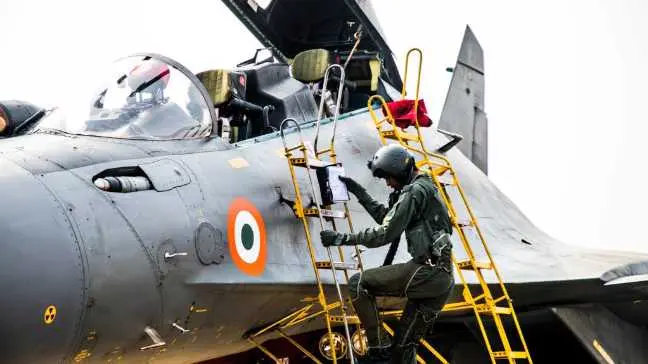
The Indian Air Force (IAF) has taken a significant step towards strengthening its air defence capabilities with the launch of a comprehensive ₹60,000 crore ($7.5 billion) upgrade plan for its Su-30MKI fleet. This ambitious initiative will enhance the combat capabilities of these fighter jets, excluding airframes and engines, over the next four to five years.
The modernization efforts will focus on upgrading avionics, radars, and electronic warfare systems, with the aim of significantly enhancing the Su-30MKI's combat capabilities. These upgrades include improvements to beyond-visual-range (BVR) capabilities, electronic warfare suites, and the introduction of a new radar system.
Indigenous development takes centre stage
Air Chief Marshal V R Chaudhary, Chief of Air Staff, emphasized the importance of indigenous development, highlighting that the upgrade would incorporate a plethora of indigenously-designed weapons and electronic warfare systems. This commitment aligns with India's drive to boost its defence capabilities while fostering indigenous technological advancements.

Over the past decade, the Su-30MKI fleet has already seen incremental upgrades, integrating indigenous weapons like the BrahMos and Astra air-to-air missiles. The latest enhancements include the introduction of new-generation anti-radiation missiles (NGARMs), such as Rudram-1, Rudram-2, Rudram-3, and Astra-2, promising to augment ground-target destruction capabilities.
Advertisement
Electronic warfare at the forefront
Electronic warfare features prominently in the upgrade program, with Hindustan Aeronautics Limited (HAL) showcasing a schematic for an electronic warfare suite during Aero India 2023. This cutting-edge suite aims to replace the existing Russian SAP-51 pods, emphasizing India's commitment to indigenous technological advancements.
Ongoing discussions with Russia since 2017 emphasize the desire to maximize indigenous systems within the aircraft. In November 2019, reports indicated that Russia would support the development of a prototype for the upgraded Su-30MKI at HAL.
Advertisement
Critical decisions on engines
A noteworthy decision in this upgrade plan is the choice not to upgrade the Su-30MKI's engines. Despite Russia's development of an engine variant suitable for the Su-30MKI, the IAF has opted to retain the existing powerplant. This decision, influenced by cost considerations and a preference for beyond-visual-range combat, may impact the fighter's overall performance.
The Su-30SM2, analogous to the Su-30MKI and featuring the AL-41F-1S engine, offers a 16 per cent increase in maximum thrust, twice the service life, and greater electrical power generation capabilities for advanced radar and EW systems. These upgrades result in improved combat capabilities, with higher-powered Irbis radar enhancing target detection ranges.
While the upgrade plan includes a new radar system, speculations suggest a radar comparable to an active electronically scanned array (AESA) unit, possibly the Tikhomirov NIIP N035 Irbis E radar currently fitted on the Su-35S. The decision to retain the existing engine may pose challenges in providing sufficient electrical power for such a radar. Using the indigenously developed Uttam AESA radar in the second tranche of upgrades presents a promising avenue for future enhancements, although further development and deployment may be required.
Strengthening India’s air defence
In addition to upgrading its Su-30MKI fleet, the IAF is actively pursuing strategic procurements valued at approximately ₹1.7 trillion ($21 billion). These investments include the procurement of 97 additional Hindustan Aeronautics TEJAS MK-1A fighters, the acquisition of 156 Light Combat Helicopters, expanding airborne early warning and control (AEW&C) platforms, and enhancing intelligence, surveillance, target acquisition, and reconnaissance capabilities.
The Su-30MKI upgrade plan represents a significant leap forward in bolstering India's air defence capabilities. While the decision not to upgrade the engine and the choice of radar technology remain subjects of scrutiny, the commitment to indigenous development and technological advancement is evident. The success of this program will undoubtedly have a substantial impact on India's strategic air power in the coming years.
Published By : Priyarag Verma
Published On: 19 October 2023 at 18:03 IST