
Updated 22 March 2022 at 16:50 IST
NASA confirms discovering over 5,000 exoplanets ranging from super-Earths to hot Jupiters
NASA says that the list includes "super-Earths" which might be rocky and bigger than our planet, "mini-Neptunes" and even planets orbiting two stars at once.
- Science News
- 2 min read

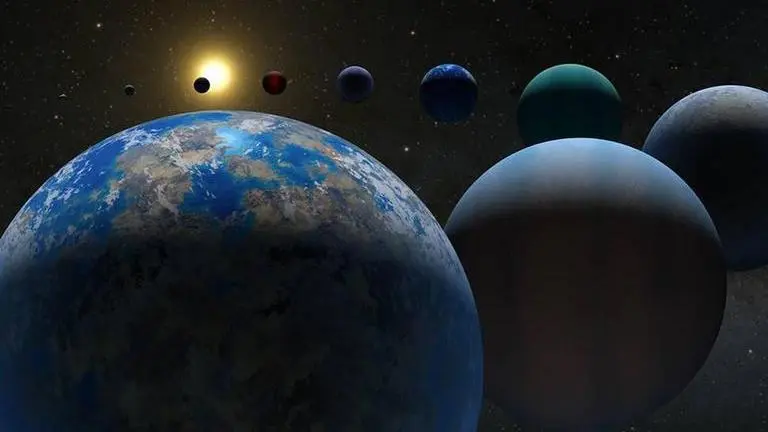
The number of planets confirmed outside our solar system has crossed the 5,000 mark, NASA revealed in a major announcement. This comes after the US space agency added 65 new exoplanets to its Exoplanet Archive. This archive consists of exoplanets whose existence was confirmed using multiple detection methods or by analytical techniques. NASA says that all of these planets include small, rocky worlds like Earth, gas giants many times larger than Jupiter, and “hot Jupiters” closely orbiting their respective stars. The list also includes "super-Earths" which might be rocky and bigger than our planet, "mini-Neptunes" and even planets orbiting two stars at once along with planets stubbornly orbiting the collapsed remnants of dead stars.
'It’s not just a number': NASA scientist
Today marks the discovery of over 5,000 known planets beyond our solar system according to the @NASAExoplanets Archive! 🤩🪐
— NASA (@NASA) March 21, 2022
Listen to decades of discovery, and learn about the significance of each sound: https://t.co/RnZwqKfYYW pic.twitter.com/ZnXWOlvAPQ
Explaining the significance of the discovery, Jessie Christiansen, NASA Exoplanet Science Institute at Caltech said as per NASA, "It’s not just a number. Each one of them is a new world, a brand-new planet. I get excited about everyone because we don’t know anything about them". The search for such exoplanets began in 1992 when NASA's numerous space telescopes began started zeroing in on the far-fetched worlds. NASA revealed that the first batch of exoplanets was orbiting a strange star, which was a neutron star known as a pulsar. A Pulsar is a rapidly spinning stellar corpse that pulses with millisecond bursts of radiation. Scientists were able to locate the planets orbiting the pulsar after measuring slight changes in the timing of the radiating pulses.
Since there are hundreds of billions of exoplanets out there, Alexander Wolszczan said, "If you can find planets around a neutron star, planets have to be basically everywhere. The planet production process has to be very robust". According to NASA, Wolszczan was the author of the paper which unveiled the first exoplanets 30 years ago. Sharing his thoughts on finding life outside Earth, Wolszczan says, "To my thinking, it is inevitable that we’ll find some kind of life somewhere – most likely of some primitive kind".
Image: NASA
Published By : Harsh Vardhan
Published On: 22 March 2022 at 16:50 IST