
Updated 15 August 2022 at 20:46 IST
Saturn makes closest approach to Earth; offers best viewing opportunity of this year
Saturn, on August 14, made its closest approach to Earth. According to NASA, it is currently orbiting the sun from a relatively closer distance of 1.32 bn km.
- Science News
- 2 min read

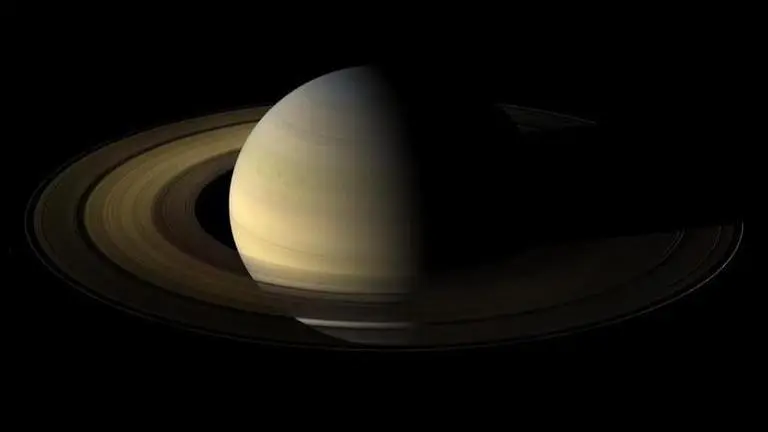
Stargazers have the best opportunity to spot Saturn as the planet just made its closest approach of the year. According to NASA, this position of the ringed planet is called ‘opposition’ wherein it is directly opposite to the sun and this period is said to have begun in the late hours of August 14. Those looking for Saturn should search for the constellation Capricornus, which would be directly behind the planet in the southern part of the night sky.
Saturn is currently in a great spot for skywatchers: close to Earth (relatively speaking) while directly opposite the Sun in our night sky.
— NASA (@NASA) August 14, 2022
Though the full Moon may get in the way, a good telescope should still be enough to zoom in on the gas giant: https://t.co/gILDMBRpvX pic.twitter.com/GMTbBkO9SP
How and when to spot Saturn
In its August astronomical guide, NASA stated that Saturn will be its closest to Earth starting August 14 and will rise around sunset and set around sunrise. Since the planet will be directly opposite the sun, it would be much more illuminated than usual given the full Moon around this time does not drown its light. Orbiting the sun from a distance of approximately 1.4 billion kilometres, Saturn is currently completing its solar revolution from 1.32 billion kilometers.
Interestingly, NASA pointed out that the planet might not be entirely faded out due to the full Moon, thanks to a unique phenomenon called the Seeliger effect. Named after late German astronomer Hugo von Seeliger, this phenomenon occurs during the brightening of a distant body or particle field when illuminated from directly behind the observer. "With Earth passing between Saturn and the Sun, the sixth planet’s icy rings are likely to brighten perceptibly in the hours around opposition", NASA said in a statement.
More about Saturn

(Saturn photographed by Cassini spacecraft in July 2013; Image: NASA)
Advertisement
Adorned with thousands of icy ringlets, Saturn is so big that its diameter spans nine Earths side-by-side but the planet takes just about 10.7 hours to complete one day. So far, 53 Moons have been confirmed orbiting the planet and 29 more are awaiting confirmation. Interestingly, many of the known Moons are believed to house conditions that could support life on them. While few missions such as Pioneer 11, Voyagers 1 and 2 and Cassini have helped scientists examine the planet, NASA is aiming to double down on it later this decade.
The agency has planned the Dragonfly mission, as part of which it will launch an 8-bladed rotorcraft to the icy surface of Titan, Saturn's largest Moon somewhere in 2027.
Advertisement
Published By : Harsh Vardhan
Published On: 15 August 2022 at 19:19 IST