
Updated 23 June 2021 at 07:27 IST
Scientists create first-ever 3-D map of the boundaries of solar system, reveal details
According to the study, heliosheath is the boundary layer between the solar system and interstellar space. Scientists were able to map the edge of heliopause.
- Science News
- 2 min read

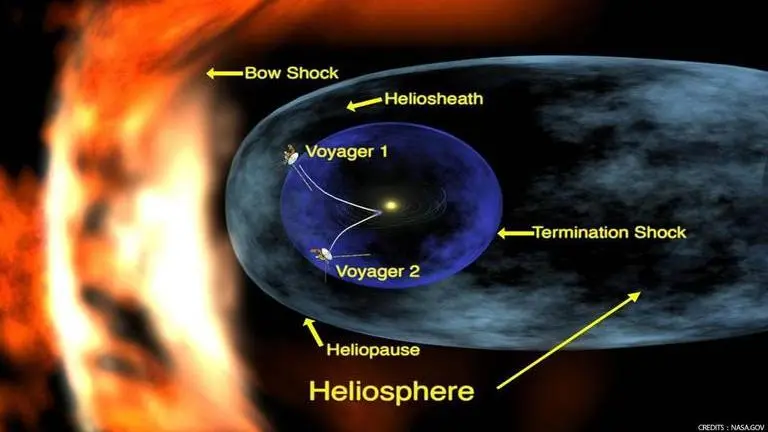
The boundary of the heliosphere has been mapped for the first time. The heliosphere is a bubble created by the solar wind, a stream of mostly protons, electrons, and alpha particles that extends from the Sun into interstellar space and protects the Earth from harmful interstellar radiation, according to the research. The findings of the research has been published in the Astrophysical Journal.
Scientists at Los Alamos National Park in the United States have developed the first 3D map of the heliosphere. Scientists used data from NASA’s Earth-orbiting Interstellar Boundary Explorer (IBEX) satellite, which detects particles that come from the heliosheath. According to the study, heliosheath is the boundary layer between the solar system and interstellar space. The team of scientists were able to map the edge of this zone, a region called the heliopause. The solar wind, which pushes out toward interstellar space, collides with the interstellar wind, which pushes in towards the Sun. Dan Reisenfeld, a scientist at Los Alamos National Laboratory and lead author on the paper, said that for the first time, scientists have measured it made a three dimensional map of it.
"Physics models have theorized this boundary for years," said Dan Reisenfeld in the press release.
Scientists used a technique similar to how bats use sonar. Scientists used IBEX satellite’s measurement of energetic neutral atoms (ENAs) that are formed due to the collisions between solar wind particles and those from the interstellar wind. The intensity of that signal depends on the intensity of the solar wind that strikes the heliosheath. When a wave hits the sheath, the ENA count goes up and IBEX can detect it. Using 10 years of data captured by NASA's Interstellar Boundary Explorer satellite, the study tracked solar-wind particles as they travelled from the sun to the edge of the solar system and back again
"The solar wind ‘signal’ sent out by the Sun varies in strength, forming a unique pattern," explained Reisenfeld.
"Just as bats send out sonar pulses in every direction and use the return signal to create a mental map of their surroundings, we used the Sun’s solar wind, which goes out in all directions, to create a map of the heliosphere," said Reisenfeld.
IMAGE: NASA.GOV
Published By : Apoorva Kaul
Published On: 23 June 2021 at 07:27 IST