
Updated 3 April 2021 at 20:37 IST
2I/Borisov is 'first truly pristine comet' to be observed, made of particles and pebbles
An unknown object which was discovered in the summer of 2019 according to researchers, is the ‘first truly pristine comet’ to have ever reached the earth.
- Science News
- 3 min read

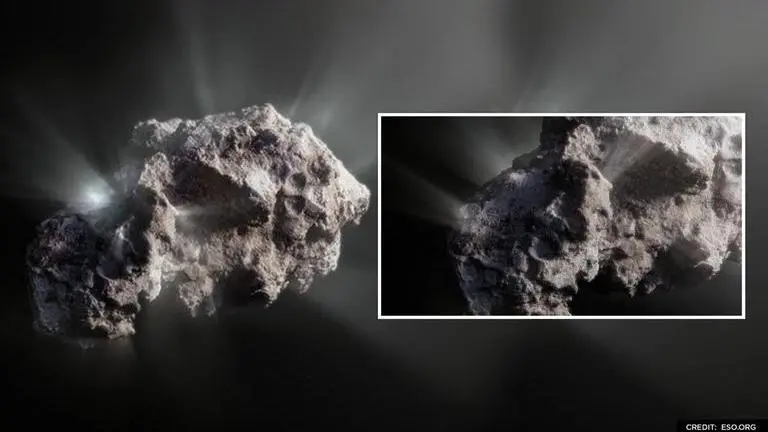
An unknown object which was discovered in the summer of 2019 from an unidentified star according to researchers, is the ‘first truly pristine comet’ to have ever reached the earth. The results of the first study launched with an aim to understand when the comet was formed, are published only this week in Nature Communications. When the comet, named 2I/Borisov arrived on Earth, no one knew what it was made from but was spotted for the first time by Ukrainian astronomer Gennady Borisov.
So far only two interstellar objects, which are often regarded as time capsules, have been observed within the solar system. The first one was 1I/‘Oumuamua that had asteroidal characteristics and 2I/Borisov according to scientists “shows clear evidence of cometary activity.” The astronomers targeted Borisov with the Very Large Telescope which is a telescope facility operated by the European Southern Observatory in the Atacama Desert, Chile and then compared the observations with other known comets.
The one comet which resembles 2I/Borisov is ‘Hale-Bopp’ or C/1995 O1, a comet that was discovered in 1995. hale-Bopp was so bright that it could be seen with a naked eye in the night for at least 18 months continuously. Now, the results of the first-ever study on 2I/Borisov reveal that it is even more intact.
The scientist wrote, “The only object with similar polarimetric properties as 2I/Borisov is comet C/1995 O1 (Hale-Bopp), an object that is believed to have approached the Sun only once before its apparition in 1997. Unlike Hale-Bopp and many other comets, though, comet 2I/Borisov shows a polarimetrically homogeneous coma, suggesting that it is an even more pristine object.”
Advertisement
“Hale-Bopp is believed to have appeared close to our Sun only once before its recent approach in 1997, therefore its material is quite pristine, but its polarimetrically homogeneous coma suggests an even more pristine nature for comet 2I/Borisov,” researchers added.
A second study on 2I/Borisov
The second study published by the journal Nature Astronomy shows that 2I/Borisov is made up of particles and pebbles of different sizes. The researchers concluded, “The interstellar traveller, 2I/Borisov, is the first clearly active extrasolar comet ever detected in our Solar System. We obtained high-resolution interferometric observations of 2I/Borisov with the Atacama Large Millimeter/submillimeter Array (ALMA) and multi-colour optical observations with the Very Large Telescope (VLT) to gain a comprehensive understanding of the dust properties of this comet. We found that the dust coma of 2I/Borisov consists of compact ‘pebbles’ of radii exceeding ~1 mm, suggesting that the dust particles have experienced compaction through mutual impacts during the bouncing collision phase in the protoplanetary disk.”
Advertisement
Image credits: eso.org
Published By : Aanchal Nigam
Published On: 3 April 2021 at 20:37 IST